A couple of weeks ago, Graham recommended a few game sites to me. It didn’t take long to get tired of Beeboxing, but solving GrowCube, the first game on EyesMaze, took much longer than I would have thought. After a few minutes of clicking the pieces in various orders, it became clear that there was a specific set of rules involved with each piece and one only had to had to figure out the rules. Since there were a finite (although large) number of playing combinations, I set about recording the results for several games:
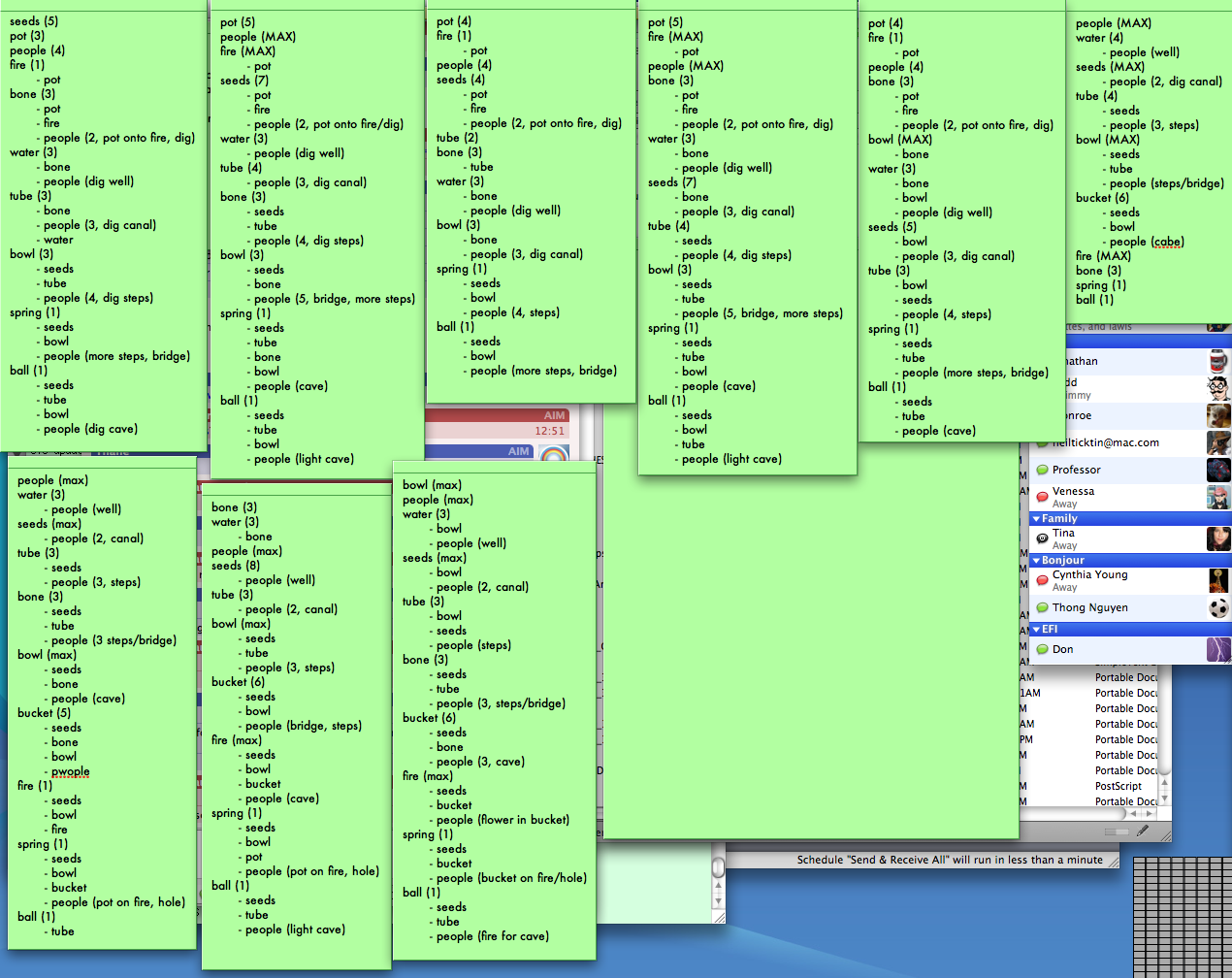
Click to enlarge
As you can tell from my copious notes, I designated the pieces on left (top to bottom) as “bone”, “water”, “ball”, “bowl” and “seeds”. The pieces on the right I called “pot” (and sometimes “bucket”), “tube”, “spring”, “people” and “fire”. I tried the pieces in different orders and recorded the actions that occurred after each play. With these results, I was able to generate a set of rules that I could test. These were the initial rules that I noted:
- People have 6 tasks
- People cannot do more than 1 task per turn
- Canal must follow well
- Steps must follow canal
- Steps/bridge must follow steps
- Cave must follow steps/bridge
- Lighting cave must follow cave
- Seeds will not grow without water
- Tube must be placed after seeds
- Fire will level up 4 turns after placement
- Fire cannot level up before pot is moved
At this point it became obvious that a long set of rules would not provide all of the information about relationships and dependencies that I needed, especially when it came to describing the changes that each object went through with each turn. So I decided to document these changes for some of the objects and try to establish rules based on those changes. I started with the most complicated objects (those requiring the most changes to reach “MAX”):
Pot life-cycle:Â Â Â Â Â Â Â Â Â Â Â Â Â Â Â Â Â Â Â
|
Seeds life-cycle:Â Â Â Â Â Â Â Â Â Â Â Â Â Â Â Â Â Â Â
|
Tube life-cycle:Â Â Â Â Â Â Â Â Â Â Â Â Â Â Â Â Â
|
Bowl life-cycle:Â Â Â Â Â Â Â Â Â Â Â Â Â Â Â Â Â Â
Bone life-cycle:
|
Water life-cycle:Â Â Â Â Â Â Â Â Â Â Â Â Â Â Â Â Â Â Â
|
People life-cycle: |
In addition, I also observed that the pieces activated during each turn in this order:
- seeds
- tube
- bone
- bowl
- pot
- people (activate water, fire, spring, ball)
Given all that, I established the following as my base play order:
- people
- water
- seeds
- tube
- pot
- fire
- bone
- bowl
- spring
- ball
After a little experimentation, I finally figured it out today (spoiler follows):
(more…)